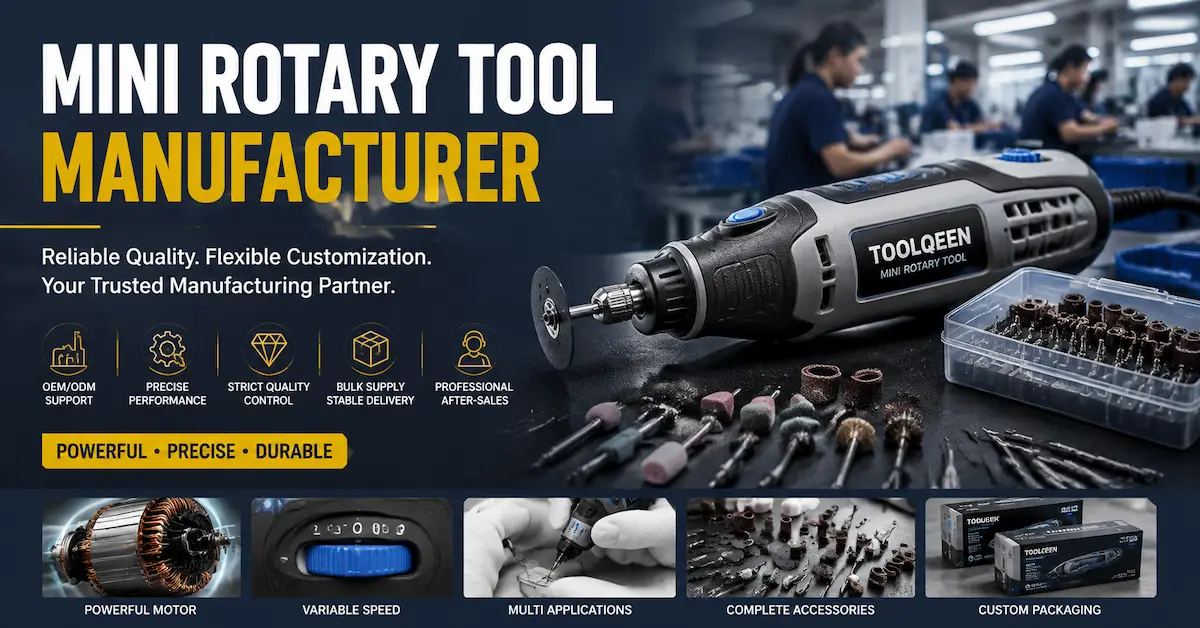

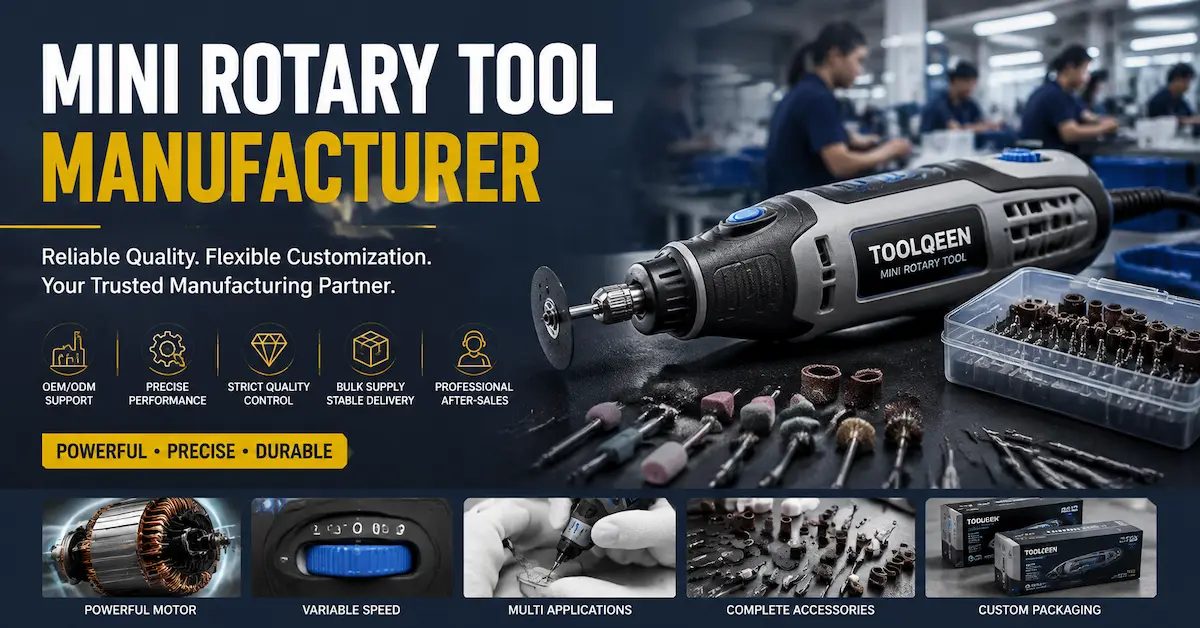
A mini rotary tool manufacturer provides compact precision tools designed for cutting, grinding, polishing, engraving, drilling, and detailed finishing applications.
For tool brands, distributors, and retailers, selecting the right manufacturer is an important decision because mini rotary tools require stable motor performance, accurate speed control, durable accessories, and consistent production quality.
Unlike standard hand tools, mini rotary tools combine mechanical structure, electrical components, and precision accessories. A reliable supplier should not only provide finished products but also support product customization, accessory configuration, packaging development, and quality control.
Working with an experienced OEM and ODM tool manufacturer allows brands to develop competitive rotary tools with stable quality and reliable supply.
What Is a Mini Rotary Tool?
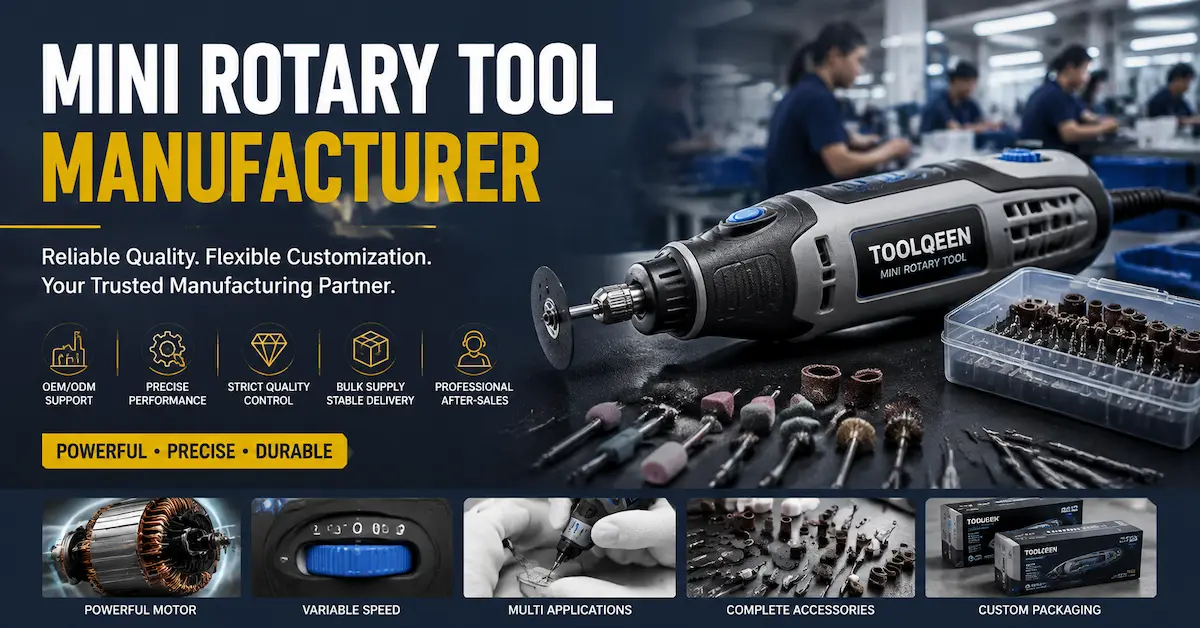
A mini rotary tool is a compact handheld power tool that uses a high-speed rotating shaft to perform precision operations.
Common applications include:
- Grinding
- Cutting
- Polishing
- Sanding
- Engraving
- Drilling
- Cleaning
- Deburring
Compared with traditional power tools, mini rotary tools offer:
- Compact size
- Flexible operation
- Better precision
- Easy accessory replacement
- Suitability for detailed work
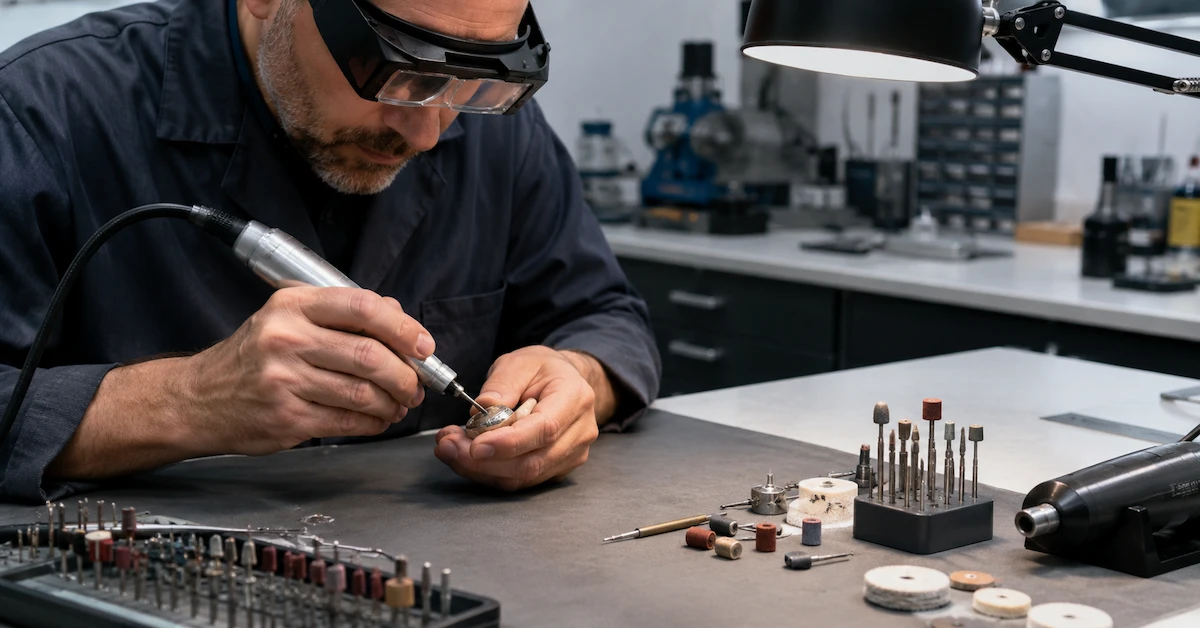
Because of their versatility, mini rotary tools are widely used in DIY projects, jewelry manufacturing, electronics repair, automotive maintenance, and industrial finishing.
Why Choose a Professional Mini Rotary Tool Manufacturer?
Choosing a professional mini rotary tool manufacturer provides several advantages for brands and distributors.
Stable Product Quality
A reliable manufacturer controls important production factors, including:
- Motor performance
- Assembly accuracy
- Electrical safety
- Accessory compatibility
- Product durability
Stable manufacturing helps reduce:
- Customer complaints
- Product returns
- Warranty issues
- Supply problems
Professional suppliers usually use structured inspection processes to ensure products meet expected performance standards.
OEM and ODM Customization Support
Different markets require different rotary tool configurations.
A professional manufacturer can support:
- Custom logo
- Product color
- Packaging design
- Accessory combinations
- Product specifications
- Private label solutions
For brands developing new products, OEM and ODM development services provide more flexibility than purchasing standard products.
Reliable Bulk Production
For distributors and global brands, production consistency is essential.
A capable manufacturer should maintain:
- Stable product specifications
- Consistent materials
- Reliable delivery schedules
- Repeat-order consistency
Direct cooperation with a manufacturer also provides better communication during product updates and future expansion.
Main Applications of Mini Rotary Tools
DIY and Hobby Projects
Mini rotary tools are popular among hobby users for:
- Wood carving
- Model making
- Craft projects
- Plastic cutting
- Surface polishing
Compact size and interchangeable accessories make them suitable for detailed creative work.
Jewelry Manufacturing
Jewelry professionals use mini rotary tools for:
- Engraving
- Polishing
- Surface finishing
- Detail correction
High precision and stable rotation are important for achieving consistent results.
Electronics Repair
Mini rotary tools are used in electronics applications such as:
- PCB modification
- Component cleaning
- Precision cutting
- Small part processing
For electronics industries, speed control and low vibration performance are key factors.
Automotive and Industrial Applications
Professional users may use mini rotary tools for:
- Rust removal
- Surface preparation
- Deburring
- Small component finishing
Key Features Buyers Should Evaluate
When selecting a mini rotary tool supplier, buyers should carefully review product specifications.
Motor Performance
The motor directly affects:
- Rotation speed
- Torque output
- Working stability
- Product lifespan
Important specifications include:
- RPM range
- Power rating
- Noise level
- Heat generation
A reliable manufacturer should provide performance testing before bulk production.
Speed Control
Different materials require different operating speeds.
Adjustable speed control allows users to work with:
- Metal
- Wood
- Plastic
- Glass
- Jewelry materials
Precise speed adjustment improves efficiency and reduces material damage.
Accessory Compatibility
Accessories are an important part of the product value.
Common accessories include:
- Grinding bits
- Cutting discs
- Sanding drums
- Polishing wheels
- Drill bits
- Brushes
- Collets
A good supplier should provide suitable accessory combinations based on target applications.
Battery and Power Options
Mini rotary tools can be designed as:
Corded Models
Advantages:
- Continuous operation
- Stable power output
- Suitable for workshops
Cordless Models
Advantages:
- Portable
- Flexible usage
- Suitable for mobile users
Important battery factors include:
- Capacity
- Charging time
- Runtime
- Protection system
How to Choose a Reliable Mini Rotary Tool Manufacturer

Check Manufacturing Experience
Before cooperation, buyers should evaluate:
- Production experience
- Export markets
- Product categories
- Customer industries
Manufacturers with industry experience usually understand different market requirements better.
Evaluate Engineering Capability
A strong supplier should provide:
- Product improvement suggestions
- Motor optimization
- Accessory matching
- Prototype support
Engineering capability is especially important for OEM and ODM projects.
Review Quality Control Process
Quality control directly affects product reliability.
Important inspection stages include:
Incoming Material Inspection
Check:
- Motors
- Batteries
- Circuit boards
- Housing materials
- Accessories
Assembly Inspection
Monitor:
- Motor installation
- Electrical connections
- Switch operation
- Speed control
Performance Testing
Test:
- RPM
- Torque
- Noise
- Temperature
- Continuous operation
Final Inspection
Verify:
- Appearance
- Accessories
- Packaging
- Quantity
A supplier with a complete quality control system can help brands maintain consistent product quality.
OEM Mini Rotary Tool vs Standard Product
| Item | Standard Product | OEM Mini Rotary Tool |
|---|---|---|
| Branding | Supplier brand | Buyer brand |
| Packaging | Standard | Customized |
| Accessories | Fixed | Adjustable |
| Product Positioning | General market | Target market |
| Development Support | Limited | Available |
| Long-term Cooperation | Lower | Higher |
For companies building their own product line, OEM cooperation provides more control over market positioning.
Common Mistakes When Choosing a Supplier
Choosing Only Based on Price
The lowest price may result in:
- Weak motors
- Poor accessories
- Short lifespan
- Higher return rates
Buyers should evaluate overall product value instead of only unit cost.
Ignoring Accessories
Accessories directly affect customer experience.
Poor accessories can reduce:
- Processing efficiency
- Product satisfaction
- Brand reputation
Skipping Sample Testing
Samples allow buyers to verify:
- Performance
- Comfort
- Noise
- Heat
- Packaging
Testing before mass production reduces risks.
Not Considering Future Supply
A reliable supplier should support:
- Repeat orders
- Product updates
- Market expansion
- Long-term cooperation
ToolQeen Mini Rotary Tool Manufacturing Support
ToolQeen provides support for buyers looking for reliable rotary tool manufacturing solutions, including:
- Product selection
- OEM customization
- ODM development
- Accessory configuration
- Packaging solutions
- Quality inspection
- Bulk production
For brands and distributors planning new rotary tool products, buyers can discuss requirements through the Contact Us page.
Recommended Applications
Mini rotary tools are suitable for:
- DIY tool brands
- Jewelry suppliers
- Electronics repair companies
- Craft product distributors
- Automotive maintenance suppliers
- Industrial tool retailers
FAQ
1. What does a mini rotary tool manufacturer provide?
A mini rotary tool manufacturer provides product design, manufacturing, customization, testing, packaging, and bulk production support for global buyers.
2. Can mini rotary tools be customized?
Yes. Buyers can customize logos, colors, packaging, accessories, product configurations, and OEM solutions according to market requirements.
3. What industries use mini rotary tools?
Mini rotary tools are commonly used in DIY, jewelry, electronics repair, automotive maintenance, crafts, and industrial finishing.
4. How do I choose a mini rotary tool supplier?
Buyers should evaluate manufacturing experience, customization capability, quality control, production capacity, and communication efficiency.
5. What is the difference between OEM and ODM rotary tools?
OEM focuses on producing according to buyer specifications, while ODM includes deeper product design and engineering development.
6. Why is accessory quality important?
Accessories directly affect cutting, polishing, engraving performance, and user experience.
7. How are mini rotary tools tested?
Manufacturers usually test speed, motor performance, temperature, noise, durability, and electrical safety.
8. Can ToolQeen support bulk orders?
Yes. ToolQeen supports customization, packaging, quality inspection, and bulk production for global customers.
Conclusion
Choosing the right mini rotary tool manufacturer is essential for brands and distributors that want reliable products and long-term market growth.
A professional supplier should provide more than manufacturing. The ideal partner should support product selection, customization, quality control, and stable production.
By working with an experienced manufacturer, businesses can develop mini rotary tools with strong performance, professional packaging, and competitive market positioning.