
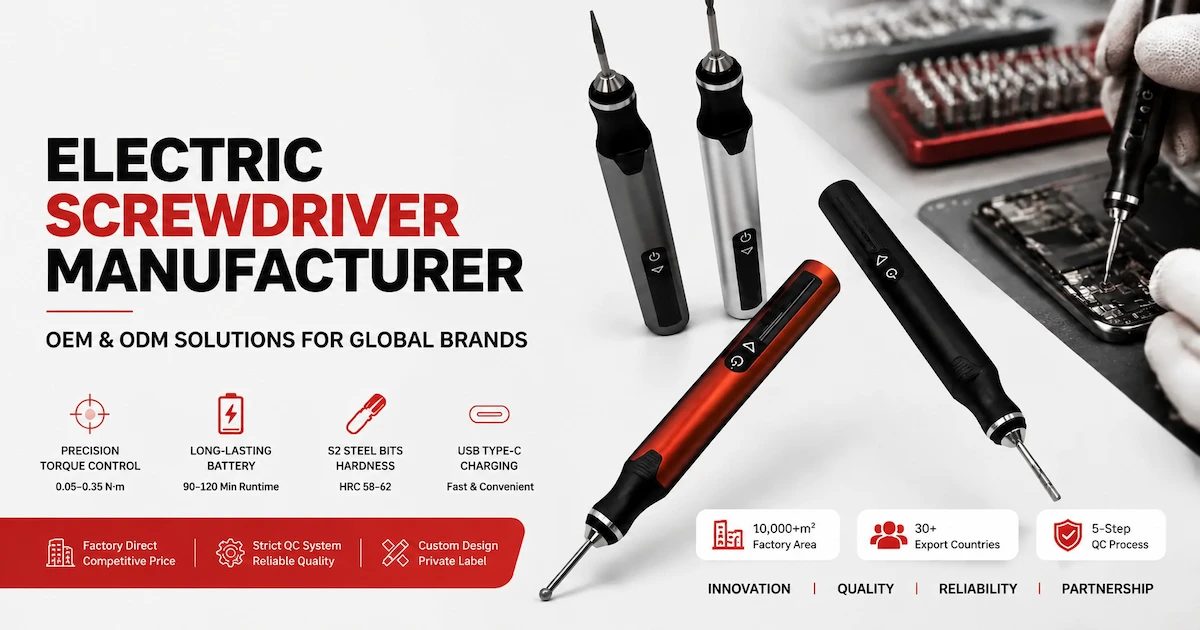
Choosing an electric screwdriver manufacturer is not simply a matter of finding the lowest quotation. For B2B buyers, the real objective is to find a factory that can deliver consistent torque, durable bits, reliable batteries, stable packaging and repeatable product quality across every production batch.
A supplier may provide an attractive sample but still struggle with torque variation, battery aging, bit wear, delayed production or inconsistent packaging during mass production. These problems can lead to customer complaints, damaged screws, negative marketplace reviews and higher after-sales costs.
The right manufacturing partner should therefore be evaluated across four areas:
- Product engineering
- Manufacturing control
- Quality assurance
- Commercial reliability
This guide explains how tool brands, distributors, importers, electronics repair suppliers and private-label sellers can evaluate an electric screwdriver factory before placing a bulk order.
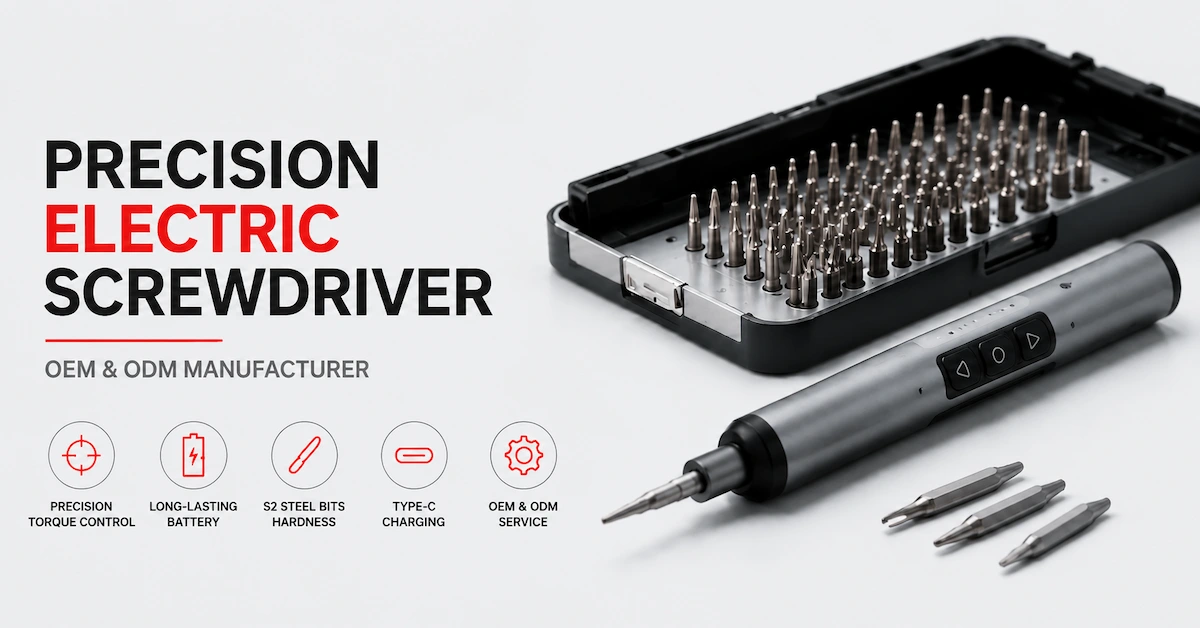
What Should an Electric Screwdriver Manufacturer Provide?
A qualified manufacturer should do more than assemble standard components purchased from several subcontractors.
The strongest suppliers can manage the main stages of product development and production, including:
- Product and structural design
- Mold development
- Injection molding
- CNC machining
- Metal component processing
- Motor and gearbox selection
- PCB and battery integration
- Bit manufacturing or material control
- Product assembly
- Torque and function testing
- Aging tests
- Packaging and shipment
Integrated manufacturing gives the supplier more control over dimensions, component compatibility, product appearance and delivery schedules.
ToolQeen states that its production system includes R&D, mold development, injection molding, metal processing, CNC machining, bit manufacturing, assembly and final inspection. The company also presents a five-stage quality system covering incoming inspection, in-process monitoring, finished-product inspection, reliability testing and pre-shipment checks.
For buyers, this type of manufacturing structure is important because a problem with one component can affect the performance of the complete screwdriver.
For example, a high-quality motor cannot compensate for a poorly aligned output shaft. Similarly, a strong bit may still damage screws if the bit dimensions are inaccurate or the torque output is unstable.
Which Buyers Need a Direct Manufacturer?
Not every buyer needs to work directly with a factory.
A direct electric screwdriver manufacturer is most suitable for companies that require:
- Private-label branding
- Custom colors or housing designs
- Customized bit combinations
- Retail-ready packaging
- Stable repeat orders
- Model exclusivity
- Torque or speed adjustments
- Market-specific certification support
- Product development
- Large-volume supply
Typical B2B buyers include tool brands, importers, distributors, electronics repair tool companies, Amazon sellers, promotional gift suppliers and industrial assembly businesses.
A small retailer purchasing a few dozen units may be better served by a local wholesaler. Direct factory cooperation becomes more valuable when the buyer needs consistent volume, product differentiation or long-term supply.
Start With the Application, Not the Product Appearance
Many buyers begin by comparing the number of bits, the shape of the storage case or the exterior color. These details matter for retail sales, but they should not be the first selection criteria.
The first question should be:
What will the screwdriver be used for?
Smartphone and consumer electronics repair
Phone, tablet, smartwatch and camera repair generally require:
- Low and controlled torque
- Compact screwdriver dimensions
- Low shaft runout
- Precision bits
- Security bit types
- LED illumination
- Lightweight handling
Too much torque can damage small screws, plastic threads or sensitive assemblies.
Laptop and computer repair
Laptop repair may require:
- Both short and extended bits
- Torx, Phillips, hex and security bits
- Manual tightening capability
- Magnetic organization
- Pry tools and tweezers
- A durable storage case
For this market, a complete repair kit may be more attractive than a screwdriver-only product.
E-commerce and retail sales
Retail and marketplace buyers usually focus on:
- Attractive packaging
- Clear product positioning
- A useful but not excessive bit selection
- Easy Type-C charging
- Simple operating instructions
- Low return rates
- Consistent appearance
- Gift-ready presentation
A 60-piece kit is not automatically better than a 30-piece kit. The ideal configuration depends on the target retail price and the applications customers actually need.
Electronics assembly
Industrial buyers may prioritize:
- Repeatable torque
- Continuous operating performance
- Ergonomic handling
- Motor durability
- Noise control
- Batch consistency
- Technical documentation
An industrial assembly tool should be evaluated differently from a consumer repair kit. Buyers should not assume that a retail precision screwdriver is suitable for continuous production-line operation.
Evaluate Torque, Speed and Mechanical Design
Torque is one of the most important technical factors when selecting a precision electric screwdriver.
However, buyers should not evaluate torque only by looking at the maximum value printed on the packaging.
A professional supplier should be able to explain:
- Electric torque range
- Manual torque capacity
- Torque adjustment method
- Torque consistency between units
- Test equipment used
- Acceptable torque tolerance
- Performance under battery discharge
- Performance after aging
Some ToolQeen product platforms are designed for precision electronics applications, while the company also states that torque and speed parameters can be adjusted for OEM projects. Buyers should confirm the exact range and tolerance for the selected model rather than applying one parameter to the entire product line.
Why torque consistency matters
Two screwdrivers may both be described as producing 0.35 N·m, but their performance may not be identical.
A unit with unstable torque can:
- Stop before the screw is fully seated
- Overtighten small fasteners
- Damage screw heads
- Produce inconsistent assembly results
- Increase product returns
Ask the manufacturer to provide sample test results or explain its torque calibration process.
Why RPM matters
Higher speed can improve efficiency, but excessive speed may reduce control during precision repair.
Buyers should consider:
- Screw size
- Thread material
- Operator experience
- Required assembly speed
- Risk of cross-threading
- Heat generated during continuous operation
The most suitable product balances speed with control rather than simply offering the highest possible RPM.
Gearbox and shaft alignment
The motor does not transmit power directly to the bit. The gearbox, output shaft, bearings and bit holder all influence performance.
Poor mechanical alignment can cause visible bit wobble, also known as shaft runout. Excessive runout makes it more difficult to engage small screws and may increase wear.
When reviewing samples, operate the screwdriver at full speed and observe the bit tip from the front and side. The rotation should appear stable rather than elliptical.
Compare Screwdriver Bit Materials and Accuracy
Bits are among the most visible wear components in a screwdriver kit.
ToolQeen uses S2 tool steel and CR-V steel in different tool configurations. The company presents S2 bits as a common choice for precision and electric screwdriver kits, while CR-V can be used in manual or extended-bit applications.
S2 tool steel
S2 steel is commonly selected for professional screwdriver bits because it can provide:
- High hardness
- Good wear resistance
- Resistance to deformation
- Suitability for repeated use
ToolQeen lists typical S2 bit hardness in the HRC 58–62 range for relevant configurations.
CR-V steel
Chrome vanadium steel can provide:
- Good toughness
- Practical cost control
- Suitability for manual tools
- Suitability for longer bits
- Resistance to brittle failure when properly processed
ToolQeen lists typical CR-V bit hardness in the HRC 52–56 range for relevant products.
The harder material is not automatically the better material for every application. Heat treatment, dimensional accuracy, tip geometry and surface finishing can be as important as the steel grade.
| Evaluation factor | What buyers should check | Possible risk |
|---|---|---|
| Material | S2, CR-V or another declared steel | Unverified or inconsistent material |
| Hardness | Tested hardness range | Premature wear or brittleness |
| Tip dimensions | Fit with standard screw profiles | Cam-out and damaged screws |
| Heat treatment | Controlled batch process | Inconsistent strength |
| Magnetism | Strength and stability | Dropped screws |
| Surface finish | Coating uniformity and corrosion resistance | Poor appearance or rust |
| Long-bit straightness | Visible alignment during rotation | Wobble in deep screw positions |
Before bulk ordering, test the most frequently used Phillips, Torx and security bits rather than inspecting only uncommon bit types.
Check the Battery, Charging System and Electronics
Battery performance has a direct effect on customer satisfaction.
A screwdriver may work well when new but develop shorter runtime, unstable speed or charging problems after repeated use.
Ask the electric screwdriver manufacturer about:
- Battery capacity
- Cell supplier
- Charging input
- Charging protection
- Overcharge protection
- Discharge protection
- Runtime test method
- Battery aging procedure
- Charging cable specification
- Transport documentation
Type-C charging is now common because it is convenient for users, but the connector alone does not guarantee a reliable charging system.
The PCB, charging management circuit, cell quality and assembly process must work together.
A useful sample test should include:
- Fully charging the unit.
- Running it repeatedly under representative load.
- Measuring operating time.
- Checking speed near low battery.
- Recharging the unit several times.
- Checking heat around the battery and PCB.
- Confirming that charging indicators work correctly.
For private-label sellers, battery-related complaints can quickly reduce product ratings. Battery testing should therefore be part of supplier selection, not just final inspection.
Examine the Manufacturer’s Quality Control System

An attractive sample does not prove that a supplier can maintain quality across 1,000 or 10,000 units.
Buyers should examine how quality is controlled during each production stage.
ToolQeen describes a five-stage process consisting of IQC, IPQC, FQC, reliability testing and pre-shipment inspection. Its website states that motors, batteries, PCBs, bits, plastic components and metal parts are checked during incoming inspection. Finished units undergo torque, function, appearance and noise testing, followed by aging and packaging verification.
IQC: Incoming quality control
Incoming inspection should verify:
- Motors
- Batteries
- PCBs
- S2 or CR-V bits
- Injection-molded parts
- Aluminum components
- Packaging materials
A supplier that skips incoming inspection may discover component problems only after final assembly.
IPQC: In-process quality control
During production, inspectors should monitor:
- Assembly alignment
- Torque calibration
- Screw fastening
- Wiring and PCB connection
- Button operation
- Housing fit
- Process parameters
In-process control prevents defects from moving through the entire production line.
FQC: Finished-product quality control
Finished-product checks should include:
- Forward and reverse operation
- Torque output
- Charging
- LED operation
- Button response
- Noise
- Appearance
- Bit and accessory quantity
Reliability testing
Depending on the product and market, reliability evaluation may include:
- Continuous operation
- Battery aging
- Drop testing
- Temperature testing
- Charging-cycle testing
- Motor life testing
- Packaging vibration or drop tests
OQC: Outgoing quality control
Before shipment, the supplier should confirm:
- Product model
- Quantity
- Logo
- Packaging
- Labels
- Barcodes
- Accessories
- Carton markings
- Documentation
Buyers should request a sample inspection report or agree on an inspection checklist before mass production.
Verify Certifications by Model and Market
Certification claims should always be checked at the model level.
ToolQeen lists CE, FCC and RoHS among its international compliance capabilities. However, buyers should confirm which certificates and reports apply to the exact product, battery, charger and destination market involved in the order.
Before ordering, request:
- Certificate or test report copies
- Product model numbers
- Applicant and manufacturer details
- Applicable standards
- Report dates
- Battery transport documents
- Label artwork
- User manual requirements
A logo printed on packaging is not a substitute for valid supporting documentation.
Certification requirements may also change depending on whether the product is sold with a battery, charging cable, adapter or wireless function.
Compare OEM and ODM Capabilities
OEM and ODM are often used interchangeably, but they describe different levels of customization.
OEM electric screwdriver projects
OEM is suitable when the buyer wants to use an existing product platform and change:
- Logo
- Housing color
- Button color
- Bit selection
- Accessories
- Packaging
- Manual
- Barcode and labels
- Standard torque or speed settings
ToolQeen states that its standard OEM service can include logo printing, housing color, button design, retail packaging, manuals and parameter modifications. Its website lists a reference MOQ of 500 pieces, a sample time of three to five days and a standard production period of approximately 10–15 days. These figures should still be confirmed for the selected model and customization scope.
ODM electric screwdriver projects
ODM involves deeper product development, such as:
- Industrial design
- Structural engineering
- New molds
- Custom PCB design
- Motor and torque system development
- Display functions
- Smart features
- Unique packaging structures
ToolQeen lists a reference ODM MOQ of 1,000 pieces and a development cycle of approximately 30–60 days. Development time can vary depending on tooling, testing, certification and design revisions.
| Project type | Typical scope | Best for | Relative cost | Relative lead time |
| Standard wholesale | Existing product and packaging | Distributors testing a market | Low | Short |
| Basic OEM | Logo, color, manual and packaging | Amazon sellers and small brands | Low to medium | Short to medium |
| Advanced OEM | Bit configuration, accessories and parameter changes | Established tool brands | Medium | Medium |
| ODM development | New structure, electronics, mold and functions | Brands seeking differentiation | High | Long |
Understand the Real Cost of an OEM Electric Screwdriver
The lowest unit price rarely represents the lowest total procurement cost.
The quotation can be affected by:
- Motor type and quality
- Gearbox construction
- Battery capacity
- PCB and charging system
- Housing material
- Number of bits
- Bit material and hardness
- Number of accessories
- Storage case
- Printing method
- Packaging structure
- Certification
- Order volume
- Inspection requirements
- Shipping method
A buyer may reduce the unit price by choosing lower-grade bits or a smaller battery, but the savings can be lost through returns and negative reviews.
A better cost evaluation includes:
Product cost + packaging cost + inspection cost + logistics cost + expected after-sales cost
When comparing suppliers, make sure each quotation is based on the same specification. Otherwise, the lowest quotation may simply describe a different product.
Common Risks When Selecting a Supplier
Comparing suppliers only by price
Low prices may result from differences in batteries, bit materials, motor quality or testing standards.
Approving only one sample
One sample does not show batch consistency. Consider a small pilot order or inspect multiple units.
Failing to define torque requirements
Words such as “high torque” or “precision torque” are not measurable specifications.
Ignoring bit dimensional accuracy
A hard bit with an inaccurate tip can still damage screws.
Using unverified certification claims
Confirm reports and model numbers before printing compliance marks.
Finalizing packaging too late
Late artwork approval can delay production even when the products are ready.
Not defining an inspection standard
Agree on functionality, appearance, accessories, packaging and acceptable defect criteria before production starts.
Electric Screwdriver Manufacturer Evaluation Checklist
Use the following checklist before approving a supplier:
| Area | Questions to ask |
| Company | Is the supplier a manufacturer or trading company? |
| Engineering | Can it explain the motor, gearbox, torque and charging system? |
| Materials | Can it confirm bit steel, hardness and treatment? |
| Production | Which processes are controlled in-house? |
| Quality | Are IQC, IPQC, FQC, aging and OQC documented? |
| Customization | Can logo, color, bits, packaging and parameters be changed? |
| Compliance | Are reports available for the selected model and market? |
| Samples | How long does sampling take, and what is included? |
| MOQ | Does MOQ change with color, packaging or structural customization? |
| Lead time | When does production time begin: deposit, sample or artwork approval? |
| Capacity | Can the factory support repeat orders and seasonal demand? |
| After-sales | How are confirmed production defects handled? |
Why Buyers Consider ToolQeen
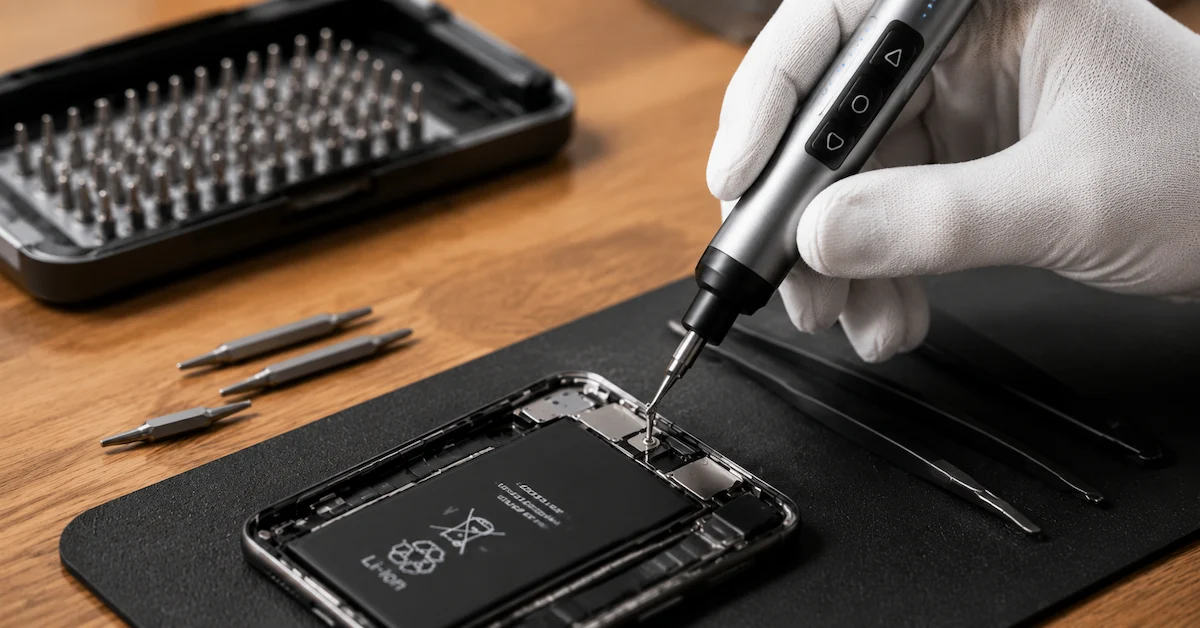
ToolQeen positions itself as a Shenzhen-based manufacturer of electric screwdrivers, precision assembly tools and mini rotary tools. The company states that it was founded in 2016 and exports to more than 30 countries.
Its relevant B2B capabilities include:
- Product and structural design
- Mold manufacturing
- Injection molding
- CNC and metal processing
- Bit manufacturing
- Assembly and aging tests
- OEM branding
- ODM product development
- Custom packaging
- Torque and speed modification
- Global shipping support
The company reports a reference monthly capacity of 80,000–120,000 units and a daily electric screwdriver output of 3,000–5,000 units. Capacity and delivery schedules should be reconfirmed according to the selected product, order date and customization requirements.
For B2B buyers, the main value is not simply the availability of an existing screwdriver. It is the ability to combine product configuration, branding, packaging, testing and delivery within one project.
Frequently Asked Questions
What is the typical MOQ for an OEM electric screwdriver?
ToolQeen lists a reference OEM MOQ of 500 pieces for customization based on an existing product platform. The actual MOQ can change according to housing color, printing, packaging, bit configuration and component modifications.
How long does it take to make an OEM sample?
A standard logo or packaging sample may take approximately three to five days after the requirements and artwork are confirmed. New structures, electronics or molds require a longer development cycle.
Can buyers customize the torque?
Standard torque or speed parameters may be adjusted for some OEM projects. The feasibility depends on the motor, gearbox, PCB, product structure and required tolerance.
Can I choose my own screwdriver bit combination?
Yes. A private-label kit can be configured around the target application, such as phone repair, laptop repair, camera maintenance or general electronics repair. Buyers should prioritize frequently used bits rather than maximizing the total piece count.
Are S2 bits always better than CR-V bits?
No. S2 is often selected for high-hardness precision bits, while CR-V can provide useful toughness for manual and extended bits. Material selection should consider the application, heat treatment, geometry and required durability.
What should I test in an electric screwdriver sample?
Test torque, speed, forward and reverse operation, shaft runout, charging, battery runtime, LED function, noise, button response, bit fit, storage case quality and packaging completeness.
Can the product color and packaging be customized?
ToolQeen states that it supports custom housing colors, button design, logo printing, retail packaging and manuals for OEM projects. Color matching and packaging details should be confirmed during sampling.
Which certifications should an importer request?
The required documents depend on the destination market and product configuration. Buyers should request model-specific compliance documents and verify whether they cover the complete product, battery and charging accessories.
How long does mass production take?
ToolQeen lists a reference period of approximately 10–15 days for standard production and 15–25 days for customized orders. Timing generally begins only after the sample, artwork, specification and payment terms are confirmed.
How can buyers reduce quality risks before shipment?
Approve a complete specification sheet, test several samples, define inspection criteria, verify packaging artwork, request production updates and arrange a pre-shipment inspection when necessary.
Conclusion
Selecting an electric screwdriver manufacturer requires a structured evaluation of engineering, materials, torque control, batteries, production processes, quality testing, certification, customization and delivery.
The most reliable partner is not necessarily the supplier offering the largest kit or lowest price. It is the manufacturer that can explain how the product is designed, demonstrate how quality is controlled and reproduce the approved specification during mass production.
Tool brands, distributors and private-label sellers should begin with a clear application, target price, required bit combination, packaging format and expected order quantity.
Share these requirements with ToolQeen to compare suitable electric screwdriver platforms, OEM options, sample arrangements and production schedules for your market.