Ratchet tools
Ratchet Screwdriver Factory Guide for OEM and Wholesale Buyers
Learn what to check when sourcing from a ratchet screwdriver factory, from bit mix and case layout to OEM customization and quality.
Published 2026-06-16 · Reviewed by the ToolQeen product and quality team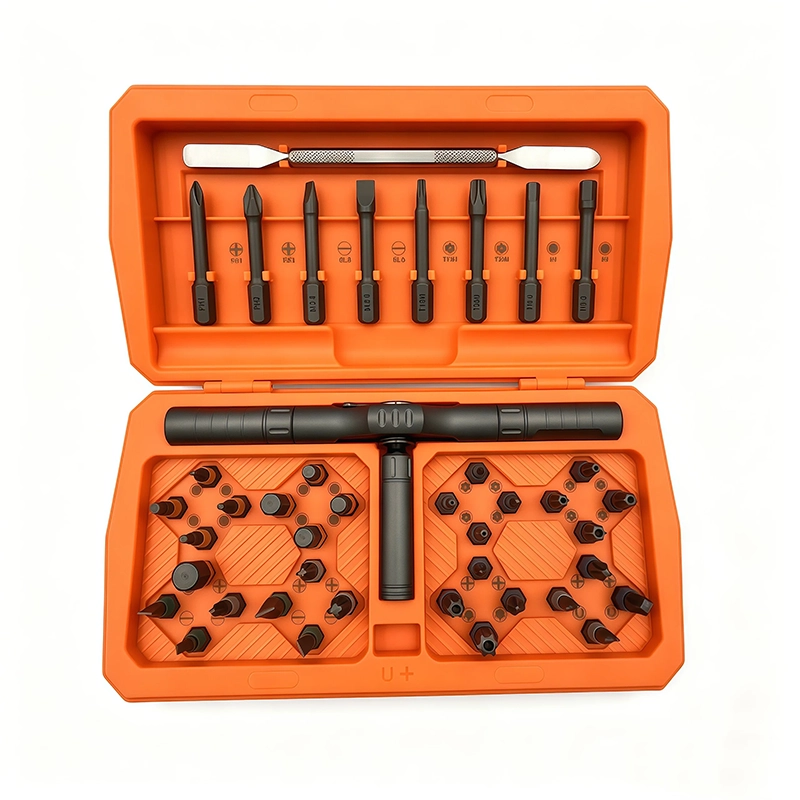
What buyers really mean when they search for a ratchet screwdriver factory
A search for a ratchet screwdriver factory is usually not just about finding a supplier. It is about finding a manufacturing partner that can deliver the right tool mix, the right packaging, and enough consistency to keep a channel moving. For sourcing managers, that often means balancing retail appeal against durability. For engineers and product teams, it means checking whether the kit is built around a sensible bit system, a workable ratchet handle, and a storage layout that makes the product easy to use instead of just easy to list.That distinction matters more than it sounds.
A ratcheting screwdriver set can look straightforward on a sales page, but the difference between a tidy, reliable tool kit and a disappointing one usually shows up in the details: bit fit, handle feel, case layout, retention strength, and how clearly the set is organized for the end user. If you are comparing a ratchet screwdriver manufacturer or evaluating a ratchet screwdriver supplier for OEM/ODM work, the goal is not to buy the most crowded kit.
The goal is to buy a set that feels coherent in hand and sensible on the shelf.
What is typically inside a ratchet screwdriver set?
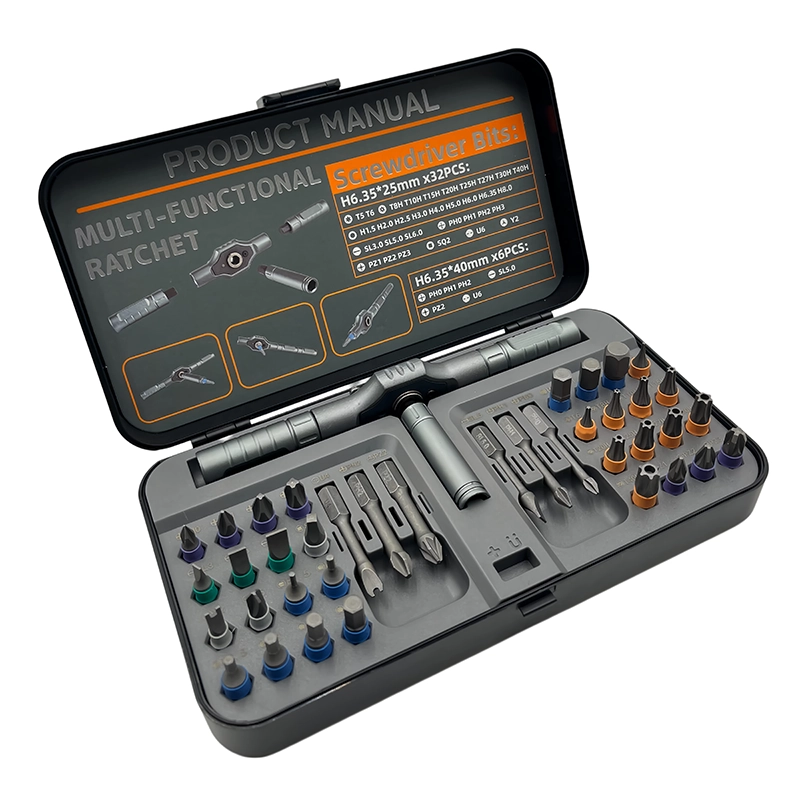
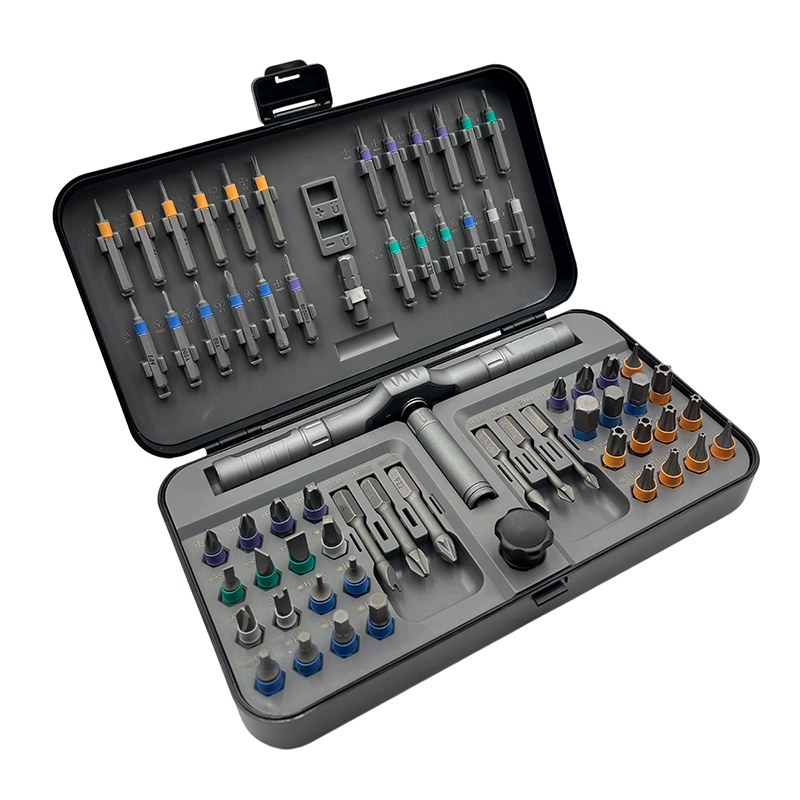
The product examples here point to a compact multi-bit kit built around a ratcheting handle, interchangeable precision bits, and a molded carry case. One version uses a hard plastic case with a dark shell and gray molded interior tray. Another uses an orange injection-molded case with fitted compartments. In both cases, the structure is familiar: a central driver handle, a set of short bits, one or more extensions or adapters, and an organized tray that keeps the pieces from rattling around.That organization is not cosmetic.
In real use, technicians and DIY users want quick visual sorting. A color-coded ring on the bit shank, a printed spec chart under the lid, and dedicated slots for each component save time and reduce errors. When the product is intended for electronics repair, small appliance maintenance, furniture adjustment, or field service, those small touches matter as much as the ratchet mechanism itself.The visible product details also suggest a 1/4-inch hex-style system in at least one configuration, with mixed short and long bits.
The lid print appears to reference H6.35*25mm and H6.35*40mm counts, though that should be verified against the final spec sheet before any procurement decision. It is the kind of detail that sounds minor until the buyer discovers the accessory ecosystem does not match the market expectation.
Why ratcheting matters in a compact hand tool kit
A ratcheting handle changes the way a screwdriver feels in use. Instead of lifting and resetting the wrist on every stroke, the user can keep continuous motion while the mechanism advances in one direction and freewheels in the other. That is useful in tight spaces and for repetitive fastening work, which is exactly where these kits tend to be used.For a professional ratchet screwdriver, the biggest advantage is speed without losing too much control.
For an industrial ratchet screwdriver, the same feature can mean fewer hand movements during service work and less strain over a long shift. The caution is simple: ratchet action is not a substitute for proper bit fit. If the bit profile is sloppy or the screw head is worn, a smooth-feeling handle will not prevent cam-out or damaged fasteners.That is why sourcing teams should look beyond the handle claims and ask how the bit set is configured.
A broad assortment helps only if the most common profiles are present in usable sizes. A kit can carry many pieces and still fail on the three drivers that customers use most often.
Manufacturing features that separate a practical kit from a cheap one
The visible construction points to a straightforward hand tool assembly process: injection-molded storage case components, machined or stamped metal driver parts, and ground bits with surface finishing for corrosion resistance and wear control. The exact steel grade, heat treatment, and coating are not provided here, and those should not be guessed in a sourcing discussion. Still, buyers can evaluate the product family using a few practical checks.First, inspect the fit between bit and holder.
A good bit system seats cleanly, releases predictably, and does not wobble excessively. Second, assess the handle grip. A knurled or ribbed metal grip can be effective, but only if the edges are comfortable and the size works for the intended user. Third, look at case retention. If the lid opens easily in transit or the bits jump out of their molded pockets, the packaging will create customer complaints even if the tool head is decent.This is where a ratchet screwdriver factory with OEM/ODM experience can be useful.
Shenzhen ToolQeen Technology Co., Ltd. positions its work around tool kits, screwdriver bits, and market-oriented configurations. That matters because a good factory should not only assemble parts. It should also help decide which combination is likely to sell in a given channel, whether the target is e-commerce, retail shelves, or repair-kit bundles.
What to ask before ordering ratchet screwdrivers wholesale
When buyers review ratchet screwdrivers wholesale offers, they often focus on the obvious items: total piece count, appearance, and packaging. Those matter, but they are only part of the picture. A more useful procurement checklist looks like this: Bit mix and profile coverage Confirm which tip profiles are included and whether the set covers the screws your customers actually encounter. Mixed Phillips, slotted, hex, Torx, and security variants can be useful, but only if the sizing is balanced.
Case structure A molded case with labeled slots is more than a storage box. It is part of the product experience. A compact case that closes securely also helps with merchandising and returns. Handle and extension system Check whether the kit includes a straight extension, a top-row adapter, or a T-handle configuration. Some users want compactness, while others want leverage. The wrong layout can make the set feel awkward even if the parts are technically correct.
Finish and corrosion resistance You do not need lab-grade metallurgy to know when a tool looks underfinished. Uneven coating, rough edges, and inconsistent color coding are usually early warning signs.
Where custom ratchet screwdriver programs make sense
A custom ratchet screwdriver program is worth considering when the buyer has a specific retail position or service use case. That may mean a branded home-repair kit, a trade giveaway for appliance service teams, a compact travel set for electronics technicians, or a market-specific bundle for online sales.ToolQeen says it offers logo printing, color options, and packaging design, which is the right kind of customization for this category.
In practical terms, that usually means the buyer can shape the look of the case, the insert layout, and the outer carton without rebuilding the entire product from scratch. For many distributors and brand owners, that is the difference between a generic listing and a product that feels coherent on arrival.The caution here is familiar: customization should not break the tool’s usability. Too much emphasis on branding can crowd the case, complicate the bit chart, or produce packaging that photographs well but opens badly.
Common mistakes buyers make with compact screwdriver kits
The first mistake is overvaluing piece count. A large set can look impressive, but if the most-used bits are hard to identify or awkward to remove, the customer experience drops quickly.The second mistake is ignoring the storage case. In this category, the case is part of the product, not just transit protection. If the molded tray is loose, the contents will shift and the kit will look used before it is even sold.The third mistake is assuming all ratchet handles feel alike.
They do not. The internal action, grip shape, and balance affect whether the tool feels efficient or fiddly. Buyers who source only by image often discover that the same visual layout can produce very different hand feel.The fourth mistake is failing to check accessory compatibility. If the bits are built around a specific hex system or length profile, that should be clear before the purchase order is placed. Small mismatches become expensive when you are stocking replacements or building a private-label line.
Practical buying advice for engineers and sourcing teams
If you are evaluating a ratchet screwdriver supplier, ask for photographs of the full open case, not just the closed product shot. Ask whether the bit list is fixed or configurable. Ask how the mold cavity is organized and whether the insert can be adapted for different markets. Those are ordinary questions, but they reveal whether the factory is selling a standard commodity or a controlled tool program.For engineering teams, the main concern is not branding.
It is repeatability. You want bits that fit the holder consistently, a ratchet mechanism that behaves the same from unit to unit, and a case that protects the set during shipping and daily use. For sourcing managers, the question is margin, but not margin alone. The lowest-cost kit often creates the highest amount of after-sales noise.Shenzhen ToolQeen Technology Co., Ltd. describes flexible sampling, stable production, and export support across Europe, North America, South America, and Australia.
Those are useful signals for buyers who need product development support as well as supply. If you are planning a tool line for Amazon, distribution, or retail, that combination can shorten the path from sample to shelf.
FAQ: quick points buyers usually ask
Is a ratchet screwdriver better than a standard driver? For repetitive fastening or tight spaces, often yes. For delicate work, the real advantage comes from control and access, not speed alone. Do precision bit sets work for general repair? They can, especially in electronics, small appliances, and furniture hardware. Just verify the common drive types before ordering. Should I prioritize the handle or the bit assortment?
Neither by itself. The set must work as a whole, and the storage case should support that system. Can these kits be customized for retail? Usually yes, at least in logo, color, and packaging. The practical limit is always the tool layout and the supplier’s mold or insert options.
What to do next if you are comparing factory options
Start with the product structure, then the bit mix, then the packaging. If a factory can show a clean open-case layout, explain the accessory system clearly, and support OEM/ODM changes without overcomplicating the design, you are probably looking at a more useful partner than a simple reseller.For buyers building a line around a ratchet screwdriver factory, the best next step is to request a sample specification and compare it against your target channel: workshop use, consumer DIY, appliance service, or electronics repair.
The right kit usually reveals itself fast once you place it in that context.
Technical review
Checked against current ToolQeen product and factory materials.
Use this guide to prepare better sourcing questions. Confirm final specifications, quantities, documents and lead times for the selected model and market.
Related product platforms