Electric screwdriver
CR-V vs S2 Screwdriver Bits Difference: Which Is Better for Precision Repair Kits?
Learn the CR-V vs S2 Screwdriver Bits Difference for precision repair kits, including durability, cost, and best uses in electronics repair.
Published 2026-06-10 · Reviewed by the ToolQeen product and quality team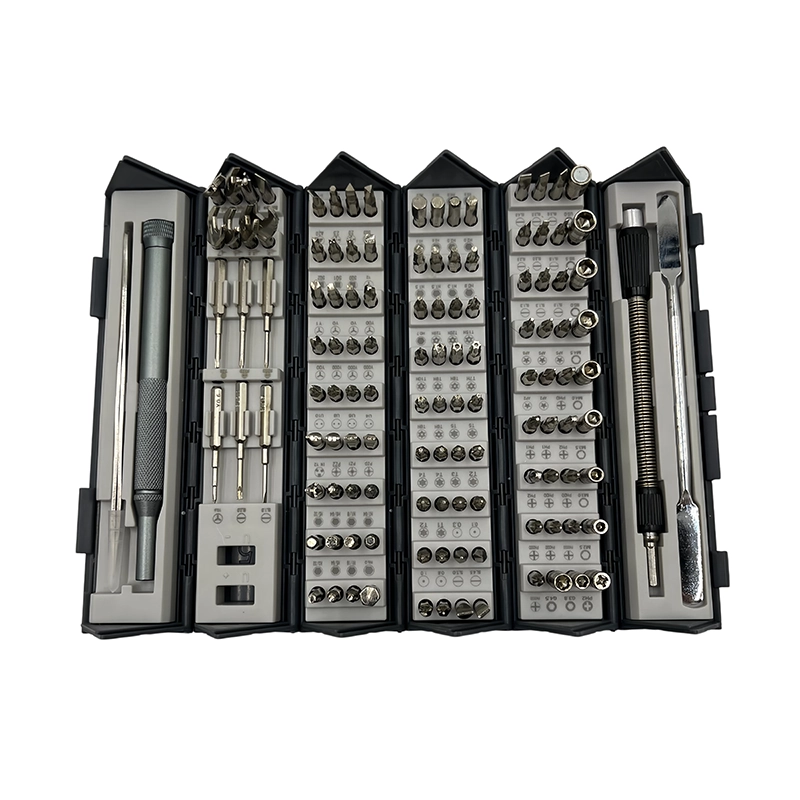
Quick Answer
If you are choosing between CR-V and S2 screwdriver bits, S2 steel generally offers higher hardness (55–62 HRC), better wear resistance, and longer service life. CR-V steel provides a lower-cost alternative with acceptable durability for light-duty repair kits. For professional electronics repair tools, S2 is usually the preferred choice.
CR-V vs S2 Screwdriver Bits Difference: what buyers really need to know
If you are sourcing a precision screwdriver set, the CR-V vs S2 Screwdriver Bits Difference is not a minor material footnote. It affects tip wear, torque transfer, service life, and how often a repair kit gets blamed for stripping screws it never should have stripped in the first place. For electronics repair, that matters more than it does in general workshop use, because the fasteners are smaller, the tolerances feel less forgiving, and a worn tip shows up quickly on a phone, tablet, watch, or glasses frame.The material choice also shapes the economics of the kit.
A bit that costs less up front can become expensive if it rounds off after repeated use, while a harder bit can look like overkill until the first batch of warranty returns or customer complaints. So the buyer’s decision is usually not “which metal is best?” but “which metal is best for this kit, this user, and this price point?”
Quick comparison: S2, CR-V, and No.45 carbon steel
The comparison graphic supplied here presents a simple hierarchy for precision screwdriver bits. S2 steel is shown as the hardest option, with a hardness range of 55–62. CR-V is shown at 50–55, and No.45 carbon steel at 40–42. The graphic also notes that CR-V raw material is about one-third the price of S2, while No.45 carbon steel is about one-sixth the price of S2.That alone tells a sourcing team a lot. S2 is positioned as the premium wear-resistant choice.
CR-V sits in the middle, balancing cost and durability. No.45 carbon steel is the budget material, but the graphic is blunt about its limitations for precision work: not hard enough, and likely to break down after a few uses.The numbers are useful, but buyers should treat them as a starting point rather than a complete technical spec. Hardness is only one part of bit performance. Geometry, heat treatment, manufacturing consistency, and fit to the screw head matter too.
A well-made CR-V bit can outperform a poorly made S2 bit in the real world, though that is hardly a comforting answer when you are trying to standardize a product line.
Why S2 is so often used in precision screwdriver bits
S2 steel is commonly selected for precision bits because it can support higher hardness without becoming impractically fragile when properly processed. In the supplied comparison, it is described as the hardest and best material for precision screwdrivers. For electronic repair, that usually translates into better edge retention at the tip and more confidence when working on small fasteners that need controlled torque rather than brute force.A practical point here: precision bits fail in a few predictable ways.
They wear at the engagement edges, twist under load, or chip when the operator applies side pressure. S2 is favored because it helps resist those failures better than softer steels, especially in sets meant for frequent use by technicians or serious DIY users.Still, “best” is a loaded word. S2 is often the better choice for premium kits, repair shop tools, and branded OEM products aimed at repeat use. It is not automatically the best choice for every low-cost accessory pack, subscription box add-on, or promotional kit that will live a gentler life in a drawer.
Where CR-V fits in electronics and repair tools
CR-V Screwdriver Bits Applications tend to sit in that middle ground where the buyer wants decent wear resistance without paying S2 pricing across a full bit assortment. The supplied material chart describes CR-V as having good hardness and abrasive resistance, with a hardness range of 50–55. That makes it a practical choice for many general repair and assembly tasks.For buyers building a repair toolkit, CR-V can be a sensible option when the kit needs to cover occasional electronics work, household maintenance, and light workshop use.
It is also often attractive when the assortment is large and the buyer wants to keep the overall bill of materials under control.The caution is simple: if the kit is meant for intensive service work, or if the target user is a technician opening devices every day, CR-V may be the point where savings start to show up as wear. That does not make it a bad material. It makes it a material that needs to be matched to the use case.
Why No.45 carbon steel is usually a poor fit for precision screwdrivers
The comparison graphic is particularly skeptical about No.45 carbon steel, and for precision screwdriver bits that skepticism is understandable. With a stated hardness of 40–42, it is presented as inexpensive but not hard enough for precision screwdrivers. The note that it may break down after a few uses is the sort of warning sourcing managers should not ignore just because the unit price looks attractive.For rougher fastening tasks, lower-cost carbon steel bits may have a place.
But in electronics repair, where screws are small and damaged heads are expensive to fix, a soft bit is a false economy. If the bit cam-outs or deforms early, the operator can damage the screw, the housing, or both. That kind of failure is not just annoying; it can turn a small repair into a replacement job.
What the visible precision repair kit tells us about product design
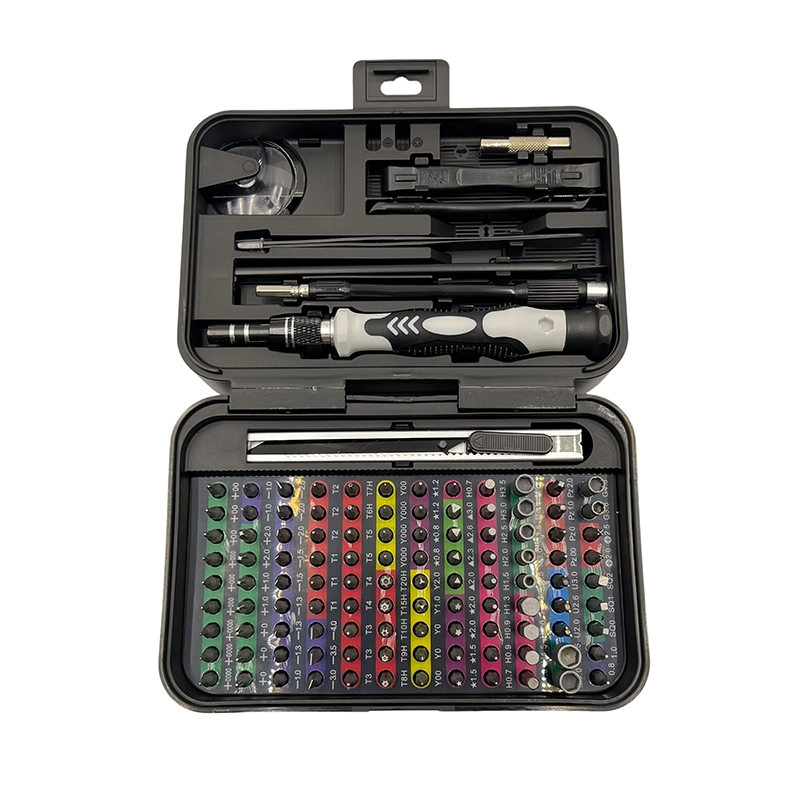
The precision screwdriver repair toolkit described in the product data is a typical electronics disassembly set, and it shows how material choices connect to the broader kit design. The set includes a retractable screwdriver handle with a molded grip, a large assortment of precision bits in a storage tray, an extension shaft, a flexible extension shaft, tweezers, pry tools, triangle opening tools, a suction cup, a SIM-eject-style pin, and a magnetization/demagnetization accessory.
It is packaged in a hard plastic carrying case with a handle and molded insert.That combination matters because the bit material is only one part of the user experience. A strong bit set loses value if the storage is messy, the handle is uncomfortable, or the accessory tools are flimsy. Likewise, a well-made case and good layout can improve perceived quality even before the user tests the first screw.For OEM and ODM buyers, this is where the kit becomes a product line rather than a pile of parts.
The assortment size, tray design, handle feel, and packaging all influence conversion on retail and e-commerce channels. Shenzhen ToolQeen Technology Co., Ltd. positions itself in exactly that space, offering OEM/ODM tool kit manufacturing, customization, and market-driven product development for distributors, wholesalers, Amazon sellers, and brand owners.
Selection criteria for buyers: what to ask before placing an order
If you are evaluating an S2 Screwdriver Bit Manufacturer or comparing an S2 vs CR-V OEM Screwdriver Bit Supplier, the first question should not be “Which material is better?” It should be “What is the kit expected to do?” That determines the material, the finishing, and the configuration.A practical buying checklist usually includes: 1. User type Is the kit for professional repair technicians, retail customers, or casual home users?
The more frequent the use, the stronger the case for S2. 2. Device type Electronics repair demands smaller, more precise bits and more careful tip durability than general hardware use. 3. Price target If the goal is a competitive retail price, CR-V may provide the best balance. If the kit is positioned as premium, S2 helps justify that positioning. 4. Kit life cycle A high-churn service shop needs repeatable performance.
A giveaway kit or light-use consumer set may not need the same material cost. 5. Packaging and assortment A well-organized case with a large assortment can offset material concerns to some degree, but it should never be used as a substitute for poor bit quality.
Common mistakes in bit sourcing
The most common mistake is to buy on material name alone. S2 has a strong reputation, but that does not tell you whether the actual bit profile fits the screw head properly, whether the heat treatment is consistent, or whether the tips are finished cleanly. CR-V can also be perfectly serviceable if the supplier controls quality well.Another mistake is assuming all precision screwdriver bits will perform similarly because they look similar on a sample card.
They often do not. Minor differences in grind quality or hardness consistency can change how the bit feels in use. For electronic repair, that difference shows up quickly.A third mistake is over-specifying the material for a low-cost line, then being surprised when the final price makes the kit uncompetitive. A better approach is to define the expected duty cycle and choose the material accordingly.
Buyer-facing practical advice
For premium repair kits, S2 is usually the safer default. It suits high-use environments, better supports repeated fastening, and aligns with buyer expectations for professional tools.For mid-range repair kits, CR-V often makes sense. It can give decent hardness and wear resistance while keeping the finished product accessible to a broader market.For bargain kits, No.45 carbon steel should be treated carefully. It may be acceptable for very light use, but it is hard to defend in a set marketed for precision electronics repair.If you are sourcing a mixed assortment, ask the supplier whether different bit groups can be built from different materials.
That is sometimes a smarter way to control cost than making every bit in the set the same way.
FAQ for sourcing teams and product managers
Is S2 always better than CR-V? Not always. S2 is typically harder and better for wear resistance, but the right choice depends on the kit’s target price and intended use. Why is CR-V still popular? Because it offers a useful middle ground. It is often strong enough for many repair applications without pushing costs too high. Can No.45 carbon steel work in precision kits? It can appear in very low-cost products, but the supplied comparison warns that it is not hard enough for precision screwdrivers and may fail early.
What should I request from a supplier? Ask for the bit material, hardness range, finishing process, and kit configuration, along with sample approval and packaging options. If you are sourcing wholesale or OEM, customization on logo, color, and box design also matters.
Choosing a supplier for the next tool line
If you are planning a new repair kit or upgrading an existing one, the material choice should be tied to market position, not just engineering preference. A precision S2 screwdriver bits wholesale program makes sense when durability and perceived quality are central to the offer. A CR-V-based line can work well when value and broad usability matter more. The wrong choice tends to show up later, in complaints, returns, or a product page full of disappointed reviews.Shenzhen ToolQeen Technology Co., Ltd.
says it supports OEM/ODM tool kit development, fast sampling, and scalable production for global customers. For buyers building electronics repair sets, that kind of one-stop approach can simplify the process, especially when the kit needs both metalworking consistency and retail-ready packaging.If you are comparing bit materials for a new precision screwdriver set, start with the target user, decide the acceptable wear life, then match the material to the price tier.
That sequence sounds basic, but it is usually where the best sourcing decisions are made.
Technical review
Checked against current ToolQeen product and factory materials.
Use this guide to prepare better sourcing questions. Confirm final specifications, quantities, documents and lead times for the selected model and market.
Related product platforms